Your brand is felt before it is understood
In my earlier posts, I explored why your story is an important part of your brand foundation, and why understanding your audience matters so much to brand strategy.
In this post, I want to explore what happens next: the experience people have when they come into contact with your brand, and how to keep that experience genuine in a world where it is getting harder to tell what is real.

This experience lives in:
Your website and how easy it is to move through.
The way you write and the tone you use.
How quickly and warmly you respond to an enquiry.
The images you share.
The way your work is presented and packaged.
And how people feel at the end of working with you.
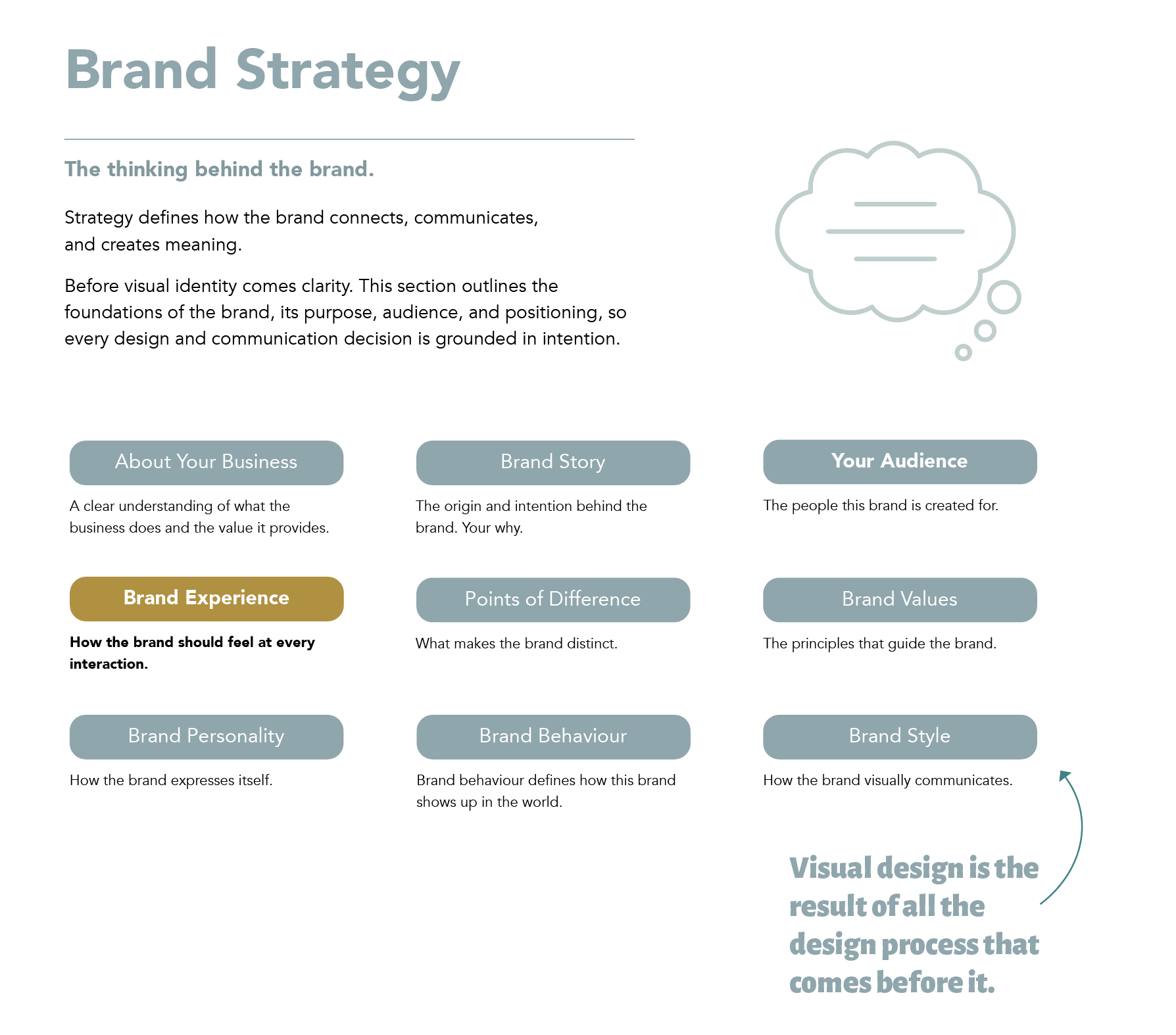
Strategy is for you. Experience is for everyone you connect with.
Your audience will never read your brand strategy document, and they do not need to. It is there for you. It gives you a clear foundation to make decisions from, helps you stay consistent when you are busy, saves you second-guessing every post, page, or proposal, and keeps your brand aligned as it grows. Your audience simply experiences the result. They form an impression quickly and instinctively. They notice whether things feel considered, whether the message matches the visuals, and whether the experience feels consistent from one place to the next.
When the experience is consistent, trust builds quietly. When it is scattered, people can feel a small sense of uncertainty, even if they cannot say why.
This is why brand experience is about more than looking good. It is about alignment. The way you show up should feel true to who you are and to what your audience is hoping to feel when they find you.
Real in a world of “maybe”
There is another layer to brand experience right now, and that is the question of what is real.
With AI tools now part of everyday marketing, more and more content is starting to feel the same. The same phrases, the same polished tone, the same perfectly smooth images. People are becoming more aware of this, and many are quietly asking themselves whether there is an actual person behind what they are reading or seeing. I know I am, and I personally want to connect with people. Gosh I even feel reassured if I see a typo these days!
We all have our own developing views around AI, I am sure. What I keep coming back to is that trust, and the feeling of genuine connection, matter more than ever.
If you choose to use AI, it can be a helpful tool for things like organising your ideas, working through a first draft, or saving time on the admin that keeps you from your real work. That is how I personally have found tools like Claude to be very helpful for me. The key is that your voice, your values, and your perspective stay at the centre. A strong brand strategy helps with this, because when you know who you are and how you want people to feel, you can tell quickly when something does not sound like you.
If you choose not to use AI, that can become part of your brand experience too, and for many audiences, that is exactly what they value.
What matters is that it is a conscious choice that reflects your values, rather than something you drift into. People may not always know how something was made, but they can feel whether it was made with care.
And I would add one more thing that is important to me as a business owner and as a client and consumer. Please be honest. If you use AI in a way your audience would want to know about, I think we should all be saying so. Transparency builds trust.
The good news is that great brand experience does not need to be complicated.
Often it begins with paying attention to the small moments and asking whether they reflect the care you put into your work.
TIP - Your Brand Experience
Experience your own brand
Take a little time to walk through your brand the way a new person would. Visit your website, read your latest post, look at your Instagram, and imagine sending yourself an enquiry.
How does each step feel?
Does it feel consistent?
Does it reflect your values and your voice?
Is there a moment where the experience feels confusing, rushed, or disconnected?
Is there anything that does not feel like you?
Where, if anywhere, does AI fit into your brand, and where does it not?
If someone read your content, would it still sound like you and would you be comfortable telling your audience how it was made?
You do not need to fix everything at once. Choosing one small touchpoint to refine can make a surprising difference to how cohesive and trustworthy your brand feels.